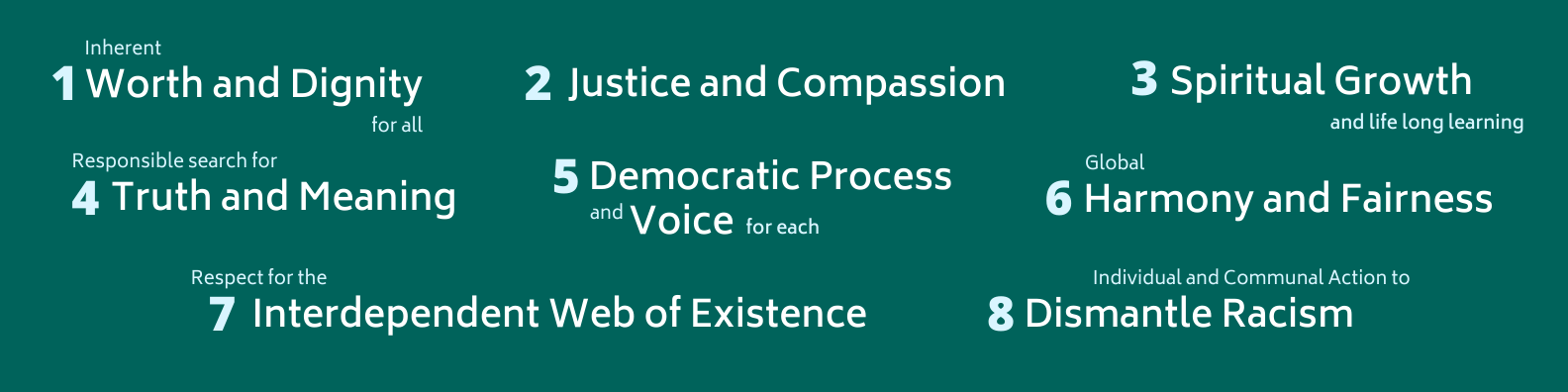
Although each of us seeks an individual truth, Unitarian Universalists are bound together by the spiritual sources and eight principles of our religious faith
Our Spiritual sourcesAs Unitarian Universalists, we share the Eight Principles of our faith and draw upon a religious pluralism that helps us deepen our under-standing and expand our vision.
The sources of this religious pluralism are: Direct experience of that transcending mystery and wonder, affirmed in all cultures which moves us to a renewal of the spirit and an openness to the forces which create and uphold life. Words and deeds of prophetic women and men which challenge us to confront powers and structures of evil with justice, compassion, and the transforming power of love. Wisdom from the world’s religions which inspires us in our ethical and spiritual life. |

|
Jewish and Christian teachings which call us to respond to divine love by loving our neighbours as ourselves.
Humanist teachings which counsel us to heed the guidance of reason and the results of science, and warn us against idolatries of the mind and spirit.
Spiritual teachings of Earth-centred traditions which celebrate the sacred circle of life and instruct us to live in harmony with the rhythms of nature.
Source: "The Principles and Sources of Our Religious Faith," Canadian Unitarian Council.
Humanist teachings which counsel us to heed the guidance of reason and the results of science, and warn us against idolatries of the mind and spirit.
Spiritual teachings of Earth-centred traditions which celebrate the sacred circle of life and instruct us to live in harmony with the rhythms of nature.
Source: "The Principles and Sources of Our Religious Faith," Canadian Unitarian Council.
The Chalice
At the opening of Sunday worship and other spiritual meetings, many UU congregations light a flame inside a chalice. This flaming chalice has become a well-known symbol of our denomination. It unites our members in worship and symbolizes the spirit of our work.
The story of the chalice
An Austrian artist and refugee from the Nazis, Hans Deutsch, became involved with the Unitarian Service Committee (USC) during World War II. The USC assisted people escaping from the Nazis and oversaw a secret network of couriers and agents. This group asked Deutsch to create a symbol for them. He drew a pencil-and-ink chalice with a flame. The flaming chalice design was made into a seal for papers and a badge for agents moving refugees to freedom. It is now a symbol of Unitarian Universalism all around the world.
The story of the chalice
An Austrian artist and refugee from the Nazis, Hans Deutsch, became involved with the Unitarian Service Committee (USC) during World War II. The USC assisted people escaping from the Nazis and oversaw a secret network of couriers and agents. This group asked Deutsch to create a symbol for them. He drew a pencil-and-ink chalice with a flame. The flaming chalice design was made into a seal for papers and a badge for agents moving refugees to freedom. It is now a symbol of Unitarian Universalism all around the world.
About Unitarian UniversalismThe First Unitarian Congregation of Ottawa follows the tenets of Unitarian Universalism—a liberal religion that combines two religious movements: Unitarianism and Universalism.
Unitarianism, which dates back to 16th century in Transylvania, began as a religious movement that opposed the idea of Holy Trinity and believed in the oneness of God, free human will, and the loving benevolence of God. Universalism, which developed in North America in the 1800s, was a reaction against strict Calvinist doctrines of eternal punishment. Universalists believed that dignity and worth is innate to all people regardless of sex, color, race, or class. Both Unitarians and Universalists believed in an inclusive theology, and they often acted together in many social justice movements in the 19th and 20th centuries. |

On behalf of the UU Ministers of Canada, we share this project from Rev. Steven Epperson and Unitarian Universalist Ministers of Canada. Permission has been granted by all contributors.
|
Unitarian Universalism. In 1961, the two movements merged and formed the Canadian Unitarian Council (CUC) in Canada and the Unitarian Universalist Association (UUA) in the United States. For 40 years, these two organizations worked closely together to provide services and programs to congregations in both countries. However, by 2000, the CUC decided that it needed to focus on specific Canadian needs. In 2002, the CUC became the main association and service provider for Unitarians and Universalists in Canada.
The Eight Principles of Unitarian Universalism
As we have no official Unitarian Universalist creed, each of us is free to search for truth on many paths. Some of us believe in a God while others do not. Some of us believe that each person houses a divine spirit while others do not believe in any sort of divinity. Our common denominator is a belief in openness, tolerance, and compassion for others and our environment. Although each of us seeks an individual truth, Unitarian Universalists are bound together by the eight principles and spiritual sources of our religious faith.
|
We, the member congregations of the Canadian Unitarian Council, covenant to affirm and promote:
|
Watch this short video, above, about what being UU is all about.
|
- individual and communal action that accountably dismantles racism and systemic barriers to full inclusion in ourselves and our institutions.